
- About
-
Solutions
Solutions
Industries
- Blogs
- Contact Us
Published on 25 November, 2025
Read time 6 min
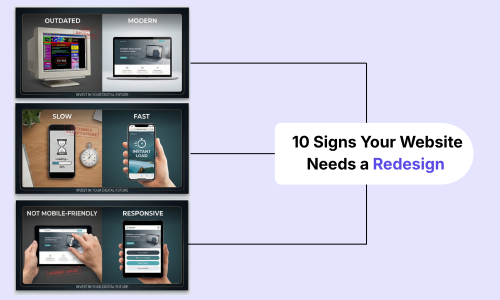


In today’s digital-first world, your website is often the first impression potential customers have of your brand. It acts as your online storefront, sales agent, customer service desk, and brand ambassador—all at the same time. But as design trends evolve, user expectations increase, and search engine algorithms change, even the best websites eventually become outdated.
If you’ve recently asked yourself, “Does my website need a redesign?”, you’re already noticing the signs. A website is not something you build once and forget. Businesses change, user behavior changes, and technology changes. That’s why recognizing the signs your website needs a redesign on time can save you from losing valuable leads, conversions, and revenue.
This guide breaks down the 10 major signs your website needs an upgrade, explains why redesigning your website matters, and helps you understand how to tell if your website needs a redesign using both user experience and SEO signals. Whether you have a small business website or a large online brand, this checklist will help you make the right decision.
One of the clearest website redesign signs is when your website simply looks old. Design trends change every 2–3 years, and what looked modern in 2020 may look outdated today.
When your competitors have clean, modern, easy-to-navigate websites and yours still looks like a template from a decade ago, users subconsciously trust them more. This is one of the major signs your business website is outdated, especially if you notice customers choosing competitors over you.
An outdated design creates bad user experience website issues because users immediately judge credibility based on visuals. If your website looks outdated, people assume your services or products are outdated too.
If this sounds familiar, it’s clearly time for a website redesign.
Speed is no longer a luxury—it's a ranking factor. A slow website signals outdated code, old hosting, and heavy media files.
This is a major website performance issues sign, and it directly affects both your SEO and conversions.
If you’re noticing drop-offs, then you’re facing old website hurting conversions scenarios.
If your website takes more than 2–3 seconds to load, you’re losing customers. A slow website redesign becomes essential because speed is a core component of user experience.
More than 65% of website traffic comes from mobile devices. Google now uses mobile-first indexing, meaning the mobile version of your site is what determines your rankings.
These are clear poor user experience website signs and a big reason behind low conversion website redesign needs.
If your website isn’t responsive, you’re not just losing customers—you’re losing search rankings. This is one of the most common signs you need a new website in today’s digital landscape.
A mobile-friendly website redesign is no longer optional—it’s mandatory.
SEO is not something you add later—your website needs to be built with SEO structure in mind. If your website is poorly optimized, it doesn’t matter how great your content or product is; Google simply won’t show it.
If your website not SEO friendly, it won’t attract organic traffic. This becomes a huge reason your website is not converting—because customers can’t find you in the first place.
You continue to fall in rankings while competitors take your traffic. That’s why understanding why redesign your website from an SEO perspective is essential.
A website’s primary purpose is to convert visitors into leads.
If you’re getting traffic but your website not generating leads, it means:
These are common issues with old websites, and they directly affect business growth.
If lead flow or sales have dropped steadily over months, it’s a direct website redesign warning sign.
A strategic redesign improves your:
These improvements transform your website from a digital brochure into a lead-generating machine.
User experience is one of the top ranking and conversion factors.
Consumers expect websites to be effortless to navigate, visually appealing, and intuitive.
These poor user experience website signs not only frustrate visitors but also reduce dwell time—hurting your SEO.
If you constantly get complaints or see people dropping off quickly, it’s time to analyze if the design is the problem. A redesign can fix your entire digital experience.
If your business has grown, rebranded, expanded services, or changed direction, your website must reflect that.
These are signs it’s time to update your website design to maintain consistency and credibility.
Your website should support your new goals, not hold you back. A fresh design aligned with your updated branding helps users trust your business more.
If your website is built on outdated technology, hard-coded pages, or unsupported themes/plugins, making even small updates becomes a headache.
This is one of the most ignored but important top signs your website needs an upgrade.
With platforms like WordPress, Webflow, or Shopify, you can easily update content, add new sections, or integrate tools—without relying on a developer every time.
Security is a major factor in user trust and SEO. Google penalizes unsafe sites, and visitors instantly leave if they see warnings.
These outdated website problems aren’t just technical—they can directly impact your business reputation.
You stay vulnerable to hacks, lose customer trust, and risk SEO penalties.
A redesign ensures modern security standards, safe coding frameworks, and up-to-date hosting.
Businesses evolve and so do customer needs. If your website can’t support the features you want to add, it’s outdated.
If your current site can’t handle these, it’s a clear website redesign checklist for businesses requirement.
A fresh redesign ensures you can scale with new technologies without limitations.
Use this business website redesign checklist to evaluate your site:
✔ Design looks old
✔ Slow loading
✔ Not mobile-friendly
✔ Not SEO-friendly
✔ Not generating leads
✔ Poor user experience
✔ Branding mismatch
✔ Difficult to update
✔ Security issues
✔ No modern features
If you checked even 3 or more, these are definitive signs your website needs a redesign immediately.
Here’s what a modern, optimized website gives you:
✓ Higher search engine rankings
✓ Better user experience
✓ Improved conversions
✓ Faster loading
✓ Stronger brand credibility
✓ More leads & sales
✓ Better mobile experience
✓ Competitive advantage
A redesign is not an expense—it’s a growth multiplier.
Your website is your most valuable digital asset. If it's outdated, slow, poorly designed, or not generating leads, you're not just losing traffic—you’re losing revenue, customers, and opportunities.
Recognizing the top signs your website needs an upgrade early helps you stay ahead of competitors. A modern, fast, SEO-friendly, conversion-optimized website transforms your online presence from “just a website” into a powerful business growth engine.
If you’ve been noticing any of these signs, it’s the perfect time for website redesign and rethinking your digital strategy.


| # |
|---|

 Web Design and Development
 Content Writing
 On page SEO
 Social Media Optimization
 Search Engine Optimization
 Health Care
 Law Firm
 Real Estate
 Dental